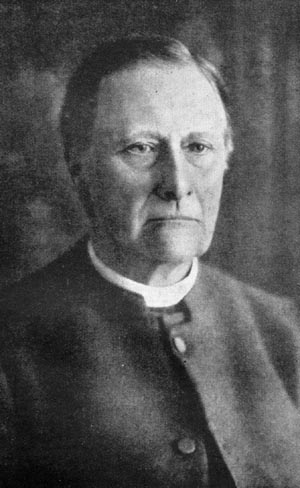
The Rev. Sabine Baring-Gould was responsible for the preservation of 800 or so folk songs from his native county of Devon and neighbouring Cornwall. Between 1888 and 1903 he undertook what he considered his most important task, collecting songs from the song men and women he came across as he travelled around seeking them out. The singers were getting on in years and Sabine realised that this wonderful store of English music was slipping away fast. Sabine was not the first to collect the songs, but his efforts made him an important member of a small group of Victorians who shared his interest.
As the collection of songs grew he decided to publish them in four parts and then in one book – Songs of the West. The latter part of the 19th century was not ready for the words of some of the songs and so he cleaned up the objectionable parts or rewrote whole songs. This has always been a sore subject with many folk performers over the years, but if the songs had not been presented in a way favourable to the drawing room set, we may not have them today. But all is not lost, as notes of words and music he made are available to us as they were taken down from the singers.
Sabine thought that the songs the old singers sang for him were broadsides, created by printers of London, Birmingham and Manchester, who churned out songs for the populace, but as his interest grew he realised that many went further back in time than he had imagined. His reference notes in "Songs of the West" show how he used his skill as a researcher to discover origins and meaning of the songs.
Sabine was not an accomplished musician, which must have presented problems when he was taking the words and tune down from a singer he had come across. Imagine a singer going through a song as this country parson writes down the words and then has the song sung over and over till he’s got the tune in his head. On one occasion he did this then drove 17 miles in his dogcart singing the song over and over until he arrived home and was able to tap the tune out on his piano and write it down.
Over the years Sabine became aware of fellow folk song collectors. He mentions Mr. Kidson (Yorkshire), Miss Broadwood (Surrey, Sussex and other counties) in Songs of the West. He knew Ralph Vaughan Williams and collaborated with Cecil Sharp on a book of songs for schools.
Mike Bosworth
is a keen researcher into the life and music of Baring-Gould.
He regularly performs in Cornwall at Women's Institutes, Village Fetes and this year took part in the first Padstow Shoestring Festival. Mike has made several appearances on BBC Radio Cornwall and has performed at two concerts at the world renowned Eden Project. Venturing across the Tamar or 'Gone broad' as they say here in Cornwall, sees Mike at Festivals and Folk Clubs, solo or with his song partner Irene Shettle.
Sifting through "Songs of the West" looking for new songs and
other sources available have thrown up some interesting ideas.
Mike says
"Talking
to Martin Graebe (who is an authoritative researcher into the Baring-Gould
Manuscripts) at the Cheltenham Folk Festival last year about songs from
Fowey has led me to more songs and a wider area to research. Martin sent
me titles of some 20 songs, which I am currently researching. I
am now looking at an area that stretches from Bodmin Moor to Liskeard,
down the Fowey River to Golant, Fowey itself and west along the coast
to the old Port of Charlestown.
This is an exciting project for me and there are some songs I hope to perform in the not too distant future. "
Hear some of Mike's recordings of Baring-Gould's collection
| Arthur McBride |
This version I learned from the singing of the late Burt Lloyd. Sabine collected a version from Sam Fone of Mary Tavy titled Arthur Le Bride, with words almost identical to that of Arthur McBride. Sabine was, in my opinion, gifted in getting information as well as songs from his singers as I here reproduce from his notes on Arthur Le Bride: Taken down from Sam Fone, Mary Tavy, by Mr. Bussell, in 1892. Sam told us that this was his father's favourite song. He had learned it from his father when he was quite a child, for the elder Fone deserted his family, and was never heard of again. But one day Sam, when aged eighteen, saw a workman standing at a cottage door, talking to someone within and he had his hand against the doorpost, clutching it as he leaned forward. Same exclaimed: "That's my father's hand!" The man turned about, and without showing his face, walked away. When Sam came from his work in the evening he made enquiries, and ascertained that a stranger had been lodging in the cottage for a few nights, but was gone. He asked the woman of the house about her lodger. "Well," said she, "I don't know his name, nor nothing about him. But he asked me for a tallow candle, and melted it up into his boots." "That was my father. It was a trick of his," said Sam, promptly. And that was the last ever seen of the man. There was one more verse in the original, omitted to reduce the lengthy ballad to singable proportions.
|
|
|
Once again a song I have sung for many years! Just like The Broken Token, this song, again from the singing of Robert Hard, changes its title to The Hearty Goodfellow, with almost identical words.
|
|
|
Collected from James Townsend of Holne, who learned it from his grandfather, William Ford who died at about seventy in 1887. This song is in several collections with varying titles e.g. Newlyn Town and The Robber. The reference to Fieldings crew! Henry Fielding was appointed chief magistrate of Westminster in 1748. After Henry's death in 1754, his blind half-brother, Sir John Fielding, who died in 1780, carried on his work of fighting crime.
|
| By Chance It Was. |
This
is the first song in Songs of the West, and is the title of this,
my first C.D. The tune and words come from James Parsons, the hedger
of Lewdown ( between Okehampton and Lifton in Devon) who had learnt
the song from his father 'The Singing Machine'. In his notes Sabine
is inclined to think that the song dates from the time of James
I or Charles I. He found the song in the British Museum in ballad
books entitled 'The Court of Apollo' and he notes that of the six
verses there, three are almost word for word as that collected from
James Parsons. |
| The Dark Eyed Sailor |
This version of The Broken Token Story I have sung for many years and once again the words are so similar to that collected from Robert Hard, it is a case of change through the oral tradition.
|
| Death and the Lady. |
Sabine was fortunate to have people who would collect songs on his behalf, this song was sent to him by Captain Hall Munro of Ingesdon House, Newton Abbott, sung to him by an old man there. In the notes on the songs in SOTW there is no mention of the source singer or the year collected, but we do find reference to a differing version in Bells 'Songs of the English Peasantry' p. 32, and that in Carey's 'Musical Century' 1738 the air of Death and the Lady is regarded as an old tune. The song was also collected from Roger Hannaford.
|
| Drunken Maidens. |
F.W. Bussell took this down from Edmund Fry of Lydford. SBG notes that the last verse had to be modified.
O' where are your maiden heads modified to O'
where be your characters Some of Sabine's children had learnt the song (perhaps before it had been 'modified') and sung it to an audience of locals who numbered several gentlefolk who must have been greatly shocked by such coarse words from the beautiful Baring-Gould girls. This has also been found in broadsides and a Breton version entitled "Merc'hed Caudan"
|
| Egloshayle Ringers |
This was the first of Sabine's songs I learnt back in the 1960's. Bell ringing was perhaps one of the national sports of Cornwall, before the boys found rugby. The ringers mentioned in the song now lie in Egloshayle Churchyard, where their gravestones can be found. Egloshayle lies on the east bank of the Camel, facing the town of Wadebridge on the west bank, just a short distance up river from the estuary at Padstow.
|
| The Emigrant's Song. |
F. W. (Freddie) Bussell collected this song in 1891 from Mary Trease of Menheniot in South East Cornwall. The song is dated prior to the American War of Independence. A Silver Mine started working in Menheniot in the 1880's and it is a possibility that a Cornish miner returning from abroad, maybe seeking a wife, brought this song with him.Here is proof that some songs came back across the Atlantic so it was not always an outward flow. Because of the American connection I had always imagined this as a country music song being sung by Willie Nelson. While we were rehearsing this song, I mentioned this to John Kirkpatrick and this is what I imagined it would sound like coming from Willie. Also found all over the UK. Amongst others, Sharp found in in Langport , Somerset in 1905. |
|
|
Here's a more traditional version of the same song |
| Go From My Window. |
This
song, with a story, is in Sabine's notes on songs in Songs of the
West. In several instances the notes of one song, in this case 'Come
to My Window' lead into another, 'Go from my Window'. This cante
fable (song & story) I found interesting as a not so common
form of folk song. Sabine writes in the notes for Come To My Window,
that it is a very early song and that the melody is the same as
from the time of Elizabeth I. He goes on to give references and
snatches of that song, which differ to the one, printed in full
(number 41 in Songs Of The West). It would be fair to assume that
Come To My Window is a night visiting song. But is Go From My Window
from an earlier time? Sabine writes the following in the notes about
Go From My Window:
|
|
|
F.W. Bussell took the words and music from Edmund Fry of Lydford, and from John Bennett of Chagford, and shepherd John Hunt of Postbridge. Sabine suggests a comparison with 'Jolly Roger Twangdillo' a ballad in d'Urfeys 'Pills to Purge Melancholy,' 1719 and a broadside version printed by Jennings of Water Lane London circ 1790, the Pepysion collection and the Roxburgh Ballads have entries with the same theme.
|
|
|
|
| Jolly Wagonner |
I remember the Watersons version of this song and I had great difficulty getting the tune in my head to this version. Sabine collected this version from James Olver, a tanner from Launceston. James came from strict Methodist parents and he and his sister were forbidden to sing anything but hymns. But young James and his sister would leave their house by their bedroom window, and sneak away to listen to the men singing in a near-by pub.
|
| Rosemary Lane |
This is the original version collected by Baring-Gould. Sabine's Notes from S.O.T.W.: Melody was taken down by W. Crossing, from an old moor man, to 'Rosemary Lane.' Roger Luxton and James Parsons also sang 'Rosemary Lane' to the same air. The words are objectionable. Moreover, in other parts of England, this Broadside song is always sung to one particular air. We therefore thought it well to put to our melody entirely fresh words. Here we see Sabine the songwriter at work. Because he found the words objectionable we end up with a totally different song to the tune of Rosemary Lane. Here we also find Sabine's vast knowledge on Folk Lore as Rosemary Lane becomes The Blue Flame. His Notes continue: It was a common belief in the West of England that a soul after death appeared as a blue flame; and that a flame came from the churchyard to the house of one doomed to die, and hovered on the doorstep till the death-doomed expired, when the soul of the deceased was seen returning with the other flame, also as a flame, to the churchyard.
|
| The Saucy Sailor. |
Another song taken down from James Parsons, Sabine gives references to broadsides that have different endings, and notes that the Devon tune is of a much earlier character. The song is meant to be sung by a male/female duo and it appears in Barrett's English Folk Songs #32 to a different tune.
|
| The Simple Ploughboy. |
These are Sabine's notes on what he describes as a charming ballad: This charming ballad was taken down, words and music, from J. Masters of Bradstone. The Broadside versions that were published by Fortey, Hodges, Taylor of Spitalfields, Ringham of Lincoln, and Pratt of Birmingham, are all very corrupt. The version of old Masters is given exactly as he sang it, and it is but one instance out of many of the superiority of the ballads handed down traditionally in the country by unlettered men to those picked up from the ballad-mongers employed by the Broadside publishers. A version of the song, 'It's of a Pretty Ploughboy,' is given in the Folk-Song Journal, vol. I. P.132, as taken down in Sussex. The words are very corrupt, and they closely resemble those on Broadsides.
|
| The Sprig of Thyme |
Once again a better version to a song is found in Sabine's Notes, although here he does state that he rewrote the words that we find printed in S.O.T.W. His notes read as follows: Taken down from James Parsons. After the second verse he broke away into 'The Seeds of Love.' Joseph Dyer, of Mawgan in Pyder, sang the same ballad or song to the same tune, and in what I believe to be the complete form of words. I added the first verse of Sabine's rewritten version to become the last verse, to extend the song time-wise.
|
| Willy Coombe |
The sad story of Willy Coombe who lost his life at Crantock Games. in 1721. This song is sometimes mixed up with "The Alturnun Volunteer".
|