|
This CD
is a mixture of songs from The Rev Sabine Baring-Gould collection. Most
of the songs are from Songs of the West (S.O.T.W.) and other sources associated
with Sabine. Some of the songs I have been singing since the 1960's, the
rest are quite recent additions to my repertoire. Over the last couple
of years I have spent many hours researching the songs and stories that
Sabine recorded in the late 19th and early 20th century, from singers
in Devon and Cornwall.
In all, Sabine collected over 800 of these songs, which are part of our
musical heritage and if he had not undertaken the task at the suggestion
of his friend Mr. Daniel Radford over dinner one night in 1888, they may
have been lost forever. When these songs were sung at the many events
that celebrated the agricultural year, or the miners' pay day in the local
pub, in most cases they would have been sung unaccompanied.
Singers
such as James Parsons with his vast repertoire are accredited to four
songs on this C.D. and clearly was Sabine's greatest contributor to his
collecting. The store of songs James had in his head is incredible when
you consider that he was illiterate; so he would have learned then by
listening to someone else sing them to him. Many of his songs came from
the singing of his father who was known as the 'Singing Machine.' The
passing of songs from father to son was perhaps just like handing over
a trade that was within a family, what we term as the oral tradition in
folk music. But the important thing here is that we are not talking about
20 or 30 songs but maybe 80 or more, with no musician to strike-up a note
to start. This I personally find incredible and James and his fellow singers
were referred to as peasants! Here were singers capable of performing
for entertainment, songs that were in musical modes that trained singers
would have had problems following on a music score, which they could read
as well as the lyrics.
Although
I too am an unaccompanied singer, my learning of these songs comes much
easier. I tape the music, learn the tune and then learn the lyrics at
my own pace. When I was learning the songs for 'By Chance It Was' I got
the feel for which songs, in my opinion, needed some musical accompaniment.
This accompaniment had to emphasis the tunes to make them stand out. So
that the music can be recognised for what it is, beautiful arrangements
preserved by the mouths of the people.
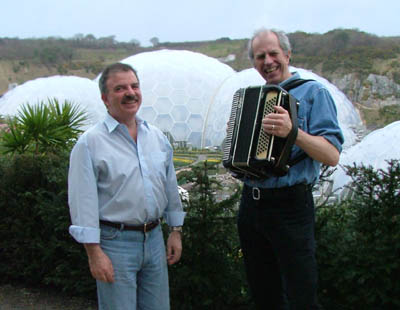
Who better to ask than John Kirkpatrick, maestro of the Accordian, Melodian
and Concertina. Working with John was a sheer delight for me and he interpreted
the tunes with the feeling that I imagined there should be. The concertina
on the title track is for me the whole point of instrumental accompaniment
to folk songs, although it is a haunting sound, it adds to the song, but
doesn't take over or impose upon it. The Drunken Maidens, with the dance-like
melodian in the background, moving the tempo up but again not taking over
in any way and the goodnight ballad, The Highway Man, with the easy on
the ear accordian keeping pace as the verses unfold. Sabine collected
a version of this with a rousing chorus, which as yet I have not found,
but I feel this is one song that benefits from musical accompaniment.
The Emigrants song I felt, since I first learned it, had a country feel
to it. When I mentioned this to John when rehearsing it, he just upped
the tempo, a little bit of swing and I followed on. It sounds nothing
like my unaccompanied version but then we need to experiment with our
folk music. On all of the accompanied tracks John interpreted the music
precisely to fit the songs, just as I has imagined they should sound.
The arrangements he worked out did justice to both the music and the lyrics.

Copies
of the C.D. are available at £11.00, which includes Postage and
Packing from:
green ltd ,
11, Torr Crescent,
Hartley,
PLYMOUTH,
PL3 5TW
Please
make cheques payable to green ltd. (Sorry no credit card facilities)
The sales
of this C.D. will help fund my next project, which are songs from Bodmin
Moor, The Fowey River and the town of Fowey. Once again John Kirkpatrick
will be involved with his musical expertise, encouragement and wit. So
if you are stuck for a present for Christmas or otherwise, there are no
restrictions on how many you can purchase.
CLICK
ON THE TITLES TO HEAR THE SONGS
Track 1 By Chance
It Was. Ref. S.O.T.W. #1.
This is
the first song in Songs of the West, and is the title of this, my first
C.D. The tune and words come from James Parsons, the hedger of Lewdown
( between Okehampton and Lifton in Devon) who had learnt the song from
his father 'The Singing Machine'. In his notes Sabine is inclined to think
that the song dates from the time of James I or Charles I. He found the
song in the British Museum in ballad books entitled 'The Court of Apollo'
and he notes that of the six verses there, three are almost word for word
as that collected from James Parsons.
Bruce Tydall, Esq. of Exmouth gave another version with a variation of
the melody, he had learnt this from a Devonshire nurse in 1839 or 1840.
The story line is similar to 'Searching for Lambs', which Cecil Sharp
collected from Mrs. Sweet (aged 62) of Somerton, Somerset in 1907. Sharp
described 'Searching for Lambs' as the most perfect folk song.
Track 2 The Saucy Sailor.
Ref. S.O.T.W. #21
Another
song taken down from James Parsons, Sabine gives references to broadsides
that have different endings, and notes that the Devon tune is of a much
earlier character. The song is meant to be sung by a male/female duo and
it appears in Barrett's English Folk Songs #32 to a different tune.
Track 3 Go From
My Window. (Notes from S.O.T.W. #41)
This song,
with a story, is in Sabine's notes on songs in Songs of the West. In several
instances the notes of one song, in this case 'Come to My Window' lead
into another, 'Go from my Window'. This cante fable (song & story)
I found interesting as a not so common form of folk song. Sabine writes
in the notes for Come To My Window, that it is a very early song and that
the melody is the same as from the time of Elizabeth I. He goes on to
give references and snatches of that song, which differ to the one, printed
in full (number 41 in Songs Of The West). It would be fair to assume that
Come To My Window is a night visiting song. But is Go From My Window from
an earlier time? Sabine writes the following in the notes about Go From
My Window:
We obtained ours from John Woodrich; he heard it in an ale-house near
Bideford in 1864, from an old man, who recited a tale, in which the song
comes in snatches. He had been soaked by the rain, and he told the tale
as he dried himself by the kitchen fire. This is almost certainly the
original framework to which these snatches of song belong. But there was
another version of the story in a ballad entitled 'The Secret Lover' or
the 'Jealous Father beguil'd to a West Country tune, or Alack! For my
love and I must dye', printed by P. Brooksby, between 1672 and 1682, given
by Mr. Ebsworth in the 'Roxburgh Ballads,' vi. P.205
Track
4 The Simple Ploughboy.
Ref. S.O.T.W. # 59
These
are Sabine's notes on what he describes as a charming ballad:
This charming
ballad was taken down, words and music, from J. Masters of Bradstone.
The Broadside versions that were published by Fortey, Hodges, Taylor of
Spitalfields, Ringham of Lincoln, and Pratt of Birmingham, are all very
corrupt. The version of old Masters is given exactly as he sang it, and
it is but one instance out of many of the superiority of the ballads handed
down traditionally in the country by unlettered men to those picked up
from the ballad-mongers employed by the Broadside publishers. A version
of the song, 'It's of a Pretty Ploughboy,' is given in the Folk-Song Journal,
vol. I. P.132, as taken down in Sussex. The words are very corrupt, and
they closely resemble those on Broadsides.
Track 5 Drunken
Maidens. Ref. S.O.T.W. # 94
F.W. Bussell
took this down from Edmund Fry of Lydford. SBG notes that the last verse
had to be modified.
O' where
are your maiden heads
Ye maidens brisk and gay
We left them in the public bar
We drank them clean away
modified
to
O' where
be your characters
Ye maidens brisk and gay
O they be a swallowed
We've drunk them clean away
Some of
Sabine's children had learnt the song (perhaps before it had been 'modified')
and sung it to an audience of locals who numbered several gentlefolk who
must have been greatly shocked by such coarse words from the beautiful
Baring-Gould girls.
Track 6 Death and
the Lady. Ref. S.O.T.W. #99
Sabine
was fortunate to have people who would collect songs on his behalf, this
song was sent to him by Captain Hall Munro of Ingesdon House, Newton Abbott,
sung to him by an old man there. In the notes on the songs in SOTW there
is no mention of the source singer or the year collected, but we do find
reference to a differing version in Bells 'Songs of the English Peasantry'
p. 32, and that in Carey's 'Musical Century' 1738 the air of Death and
the Lady is regarded as an old tune. The song was also collected from
Roger Hannaford.
Track 7 I
Rode My Little Horse. Ref. S.O.T.W. #101
F.W. Bussell
took the words and music from Edmund Fry of Lydford, and from John Bennett
of Chagford, and shepherd John Hunt of Postbridge. Sabine suggests a comparison
with 'Jolly Roger Twangdillo' a ballad in d'Urfeys 'Pills to Purge Melancholy,'
1719 and a broadside version printed by Jennings of Water Lane London
circ 1790, the Pepysion collection and the Roxburgh Ballads have entries
with the same theme.
Track 8 Arthur McBride.
Ref. S.O.T.W. # 112
This version
I learned from the singing of the late Burt Lloyd. Sabine collected a
version from Sam Fone of Mary Tavy titled Arthur Le Bride, with words
almost identical to that of Arthur McBride. Sabine was, in my opinion,
gifted in getting information as well as songs from his singers as I here
reproduce from his notes on Arthur Le Bride:
Taken
down from Sam Fone, Mary Tavy, by Mr. Bussell, in 1892. Sam told us that
this was his father's favourite song. He had learned it from his father
when he was quite a child, for the elder Fone deserted his family, and
was never heard of again. But one day Sam, when aged eighteen, saw a workman
standing at a cottage door, talking to someone within and he had his hand
against the doorpost, clutching it as he leaned forward. Same exclaimed:
"That's my father's hand!" The man turned about, and without
showing his face, walked away. When Sam came from his work in the evening
he made enquiries, and ascertained that a stranger had been lodging in
the cottage for a few nights, but was gone. He asked the woman of the
house about her lodger. "Well," said she, "I don't know
his name, nor nothing about him. But he asked me for a tallow candle,
and melted it up into his boots." "That was my father. It was
a trick of his," said Sam, promptly. And that was the last ever seen
of the man.
There
was one more verse in the original, omitted to reduce the lengthy ballad
to singable proportions.
Track 9 Jolly Wagonner
I remember the Watersons version of this song and I had great difficulty
getting the tune in my head to this version. Sabine collected this version
from James Olver, a tanner from Launceston. James came from strict Methodist
parents and he and his sister were forbidden to sing anything but hymns.
But young James and his sister would leave their house by their bedroom
window, and sneak away to listen to the men singing in a near-by pub.
Track
10 The Sprig of Thyme.
Ref. S.O.T.W. # 7
Once again
a better version to a song is found in Sabine's Notes, although here he
does state that he rewrote the words that we find printed in S.O.T.W.
His notes read as follows:
Taken
down from James Parsons. After the second verse he broke away into 'The
Seeds of Love.' Joseph Dyer, of Mawgan in Pyder, sang the same ballad
or song to the same tune, and in what I believe to be the complete form
of words.
I added
the first verse of Sabine's rewritten version to become the last verse,
to extend the song time-wise.
Track
11 Egloshayle Ringers
This was
the first of Sabine's songs I learnt back in the 1960's. Bell ringing
was perhaps one of the national sports of Cornwall, before the boys found
rugby. The ringers mentioned in the song now lie in Egloshayle Churchyard,
where their gravestones can be found. Egloshayle lies on the east bank
of the Camel, facing the town of Wadebridge on the west bank, just a short
distance up river from the estuary at Padstow.
Track
12 The Bold Highwayman
Collected
from James Townsend of Holne, who learned it from his grandfather, William
Ford who died at about seventy in 1887. This song is in several collections
with varying titles e.g. Newlyn Town and The Robber.
The reference
to Fieldings crew! Henry Fielding was appointed chief magistrate of Westminster
in 1748. After Henry's death in 1754, his blind half-brother, Sir John
Fielding, who died in 1780, carried on his work of fighting crime.
Track 13 Rosemary
Lane. Ref. S.O.T.W. #67
Sabine's
Notes from S.O.T.W.:
Melody
was taken down by W. Crossing, from an old moor man, to 'Rosemary Lane.'
Roger Luxton and James Parsons also sang 'Rosemary Lane' to the same air.
The words are objectionable. Moreover, in other parts of England, this
Broadside song is always sung to one particular air. We therefore thought
it well to put to our melody entirely fresh words.
Here we
see Sabine the songwriter at work. Because he found the words objectionable
we end up with a totally different song to the tune of Rosemary Lane.
Here we also find Sabine's vast knowledge on Folk Lore as Rosemary Lane
becomes The Blue Flame.
His Notes
continue:
It was
a common belief in the West of England that a soul after death appeared
as a blue flame; and that a flame came from the churchyard to the house
of one doomed to die, and hovered on the doorstep till the death-doomed
expired, when the soul of the deceased was seen returning with the other
flame, also as a flame, to the churchyard.
Track 14 The Dark
Eyed Sailor.
This version
of The Broken Token Story I have sung for many years and once again the
words are so similar to that collected from Robert Hard, it is a case
of change through the oral tradition.
Track 15 Bold Gambling
Boy.
Once again
a song I have sung for many years! Just like The Broken Token, this song,
again from the singing of Robert Hard, changes its title to The Hearty
Goodfellow, with almost identical words.
Track 16 The Emigrant's
Song.
F. W. (Freddie) Bussell collected this song from Mary Trease of Menheniot
in South East Cornwall. The song is dated prior to the American War of
Independence. A Silver Mine started working in Menheniot in the 1880's
and it is a possibility that a Cornish miner returning from abroad, maybe
seeking a wife, brought this song with him.
Here is
proof that some songs came back across the Atlantic so it was not always
an outward flow. Because of the American connection I had always imagined
this as a country music song being sung by Willie Nelson. While we were
rehearsing this song, I mentioned this to John Kirkpatrick and this is
what I imagined it would sound like coming from Willie.
|